A/B testing tools for the Next.js App Router, compared (2026)
We make one of the tools on this list, so read it with that in mind. We stuck to what each vendor documents, linked a source for every claim and left out any number we couldn't confirm on the vendor's own site. Everything here was last checked on November 7, 2026; if something has changed since, tell us and we'll fix it.
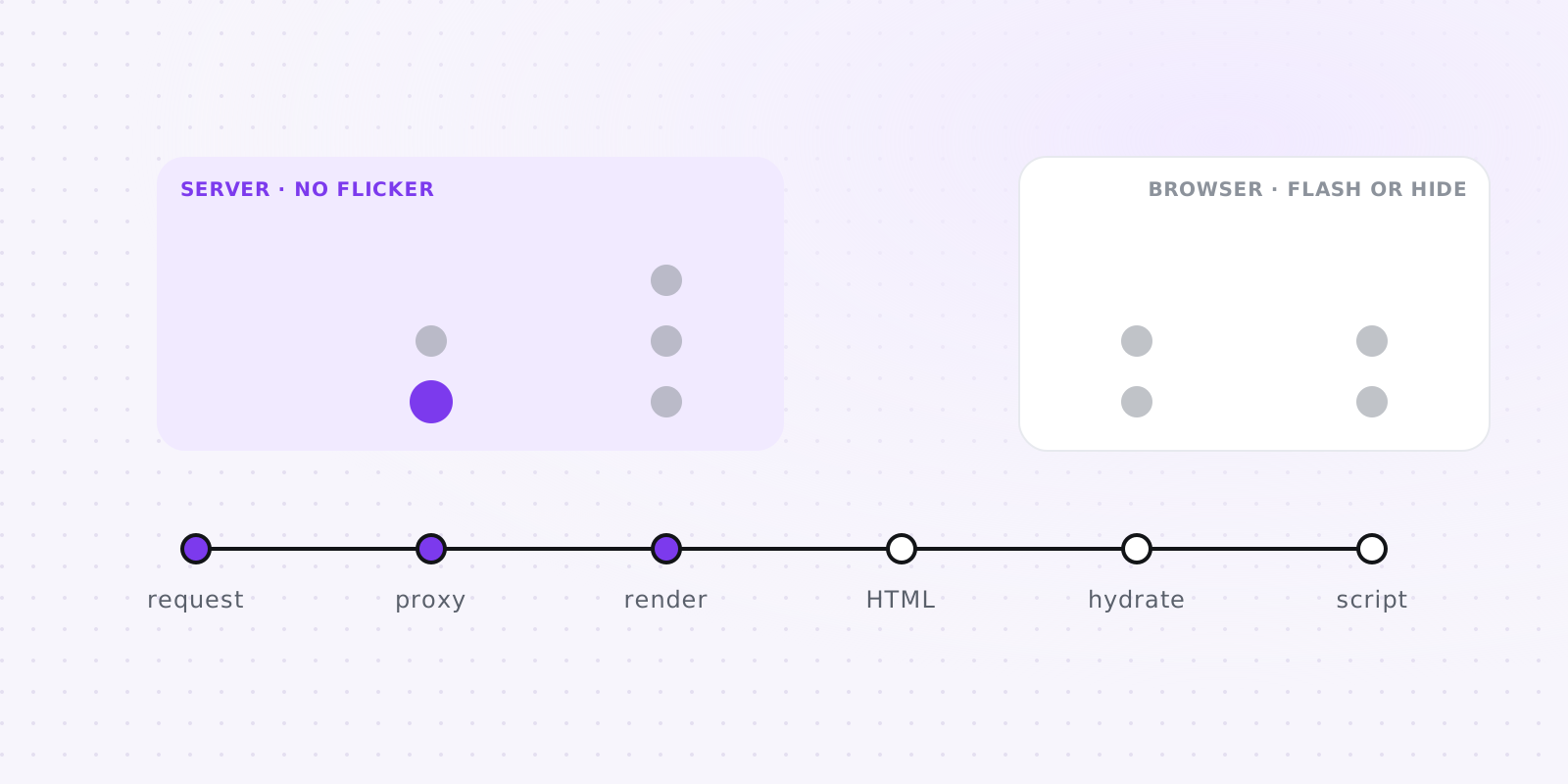
For a Next.js app, the feature list matters less than where the variant gets decided. Decide it in the browser after the page loads and you either flash the original before the variant appears or hide the page until a script runs (we wrote about what that does to LCP). Decide it on the server before rendering and neither happens.
#The short table
| Tool | Where the variant is decided | Where event data lives | Stats | Public price |
|---|---|---|---|---|
| GrowthBook | SDKs, incl. a Vercel Flags SDK provider | Your warehouse (or their managed one) | Bayesian or frequentist; sequential and CUPED on Pro | Free (3 users); Pro $40/seat/month |
| Croct | Next.js SDK, server-side | Croct's cloud | Bayesian | Free to 10K MAU; Growth from $100/month (annual) |
| Vercel Flags | Flags SDK, precompute in the proxy |
Vercel | None built in; pair with an analytics partner | Usage-based |
| PostHog | SDK; server bootstrap avoids flicker | PostHog's cloud | Bayesian or frequentist | First 1M flag requests/month free |
| Optimizely | Head snippet (Web); server SDKs (Feature Exp.) | Optimizely's cloud | Sequential (mSPRT) with false discovery rate control | Not public |
| VWO (Wingify) | SmartCode script | VWO's cloud | Bayesian with sequential correction | Not listed |
| Kameleoon | Client engine after hydration, with anti-flicker CSS | Kameleoon's cloud | Not checked | Not public |
| AB Tasty | Script, or Flagship server SDK | AB Tasty's cloud | Not checked | Sales-led |
| evolveAB | Next.js proxy, from a local signed bundle | Your Postgres; we get aggregates only | Bayesian; Thompson-sampling bandits | 30-day free trial; Pro $149/site/month |
#Built for developers
GrowthBook is open source and warehouse-native: it runs experiment analysis as SQL against your own data warehouse, which suits teams that already have one. Every plan gets Bayesian and frequentist engines, Pro and up add sequential testing and CUPED (pricing), and there's a provider for Vercel's Flags SDK (GrowthBook blog). Feature flagging and statistical depth are where it's strongest. With a warehouse and a data team behind you, it's a serious choice.
Croct is the one to look at for personalization. Croct has an official Next.js SDK with an npx croct@latest init setup and a Vercel integration, and it pairs content personalization with testing. Its pricing is public, which we appreciate: free up to 10,000 monthly active users, then Growth from $100/month billed annually (pricing).
Vercel Flags went generally available on April 16, 2026 (Vercel community). The Flags SDK's precompute pattern serves static variants from the proxy. That's the right serving model, and our static mode works the same way, but Flags has no stats engine: you assign with Flags and analyze somewhere else.
PostHog builds experiments on its feature flags and analyzes them with Bayesian or frequentist methods (docs). You can bootstrap flags from the server so the first render already has the right variant. If PostHog is your product analytics already, it's the obvious place to start.
#The visual-editor suites
Optimizely, VWO (now part of Wingify, after the merger with AB Tasty announced in January 2026), Kameleoon and AB Tasty grew up around a script on the page and an editor for marketers, with the data in the vendor's cloud. Several now document a server-side path as well. Optimizely has server SDKs and Performance Edge, and AB Tasty has a guide to avoiding flicker with Next.js SSR through its Flagship SDK (AB Tasty docs).
Their App Router docs show where the default path lands, though. Optimizely's React SSR guide says to run experiment code after hydration and warns that flicker may occur (Optimizely docs); Kameleoon's Next.js guide does the same and adds anti-flicker CSS (Kameleoon docs). These are mature products, and Optimizely's Stats Engine is especially well documented. None of the four publishes prices.
#Where evolveAB fits
We built evolveAB for a Next.js App Router site that wants server-rendered tests, a results page a marketer can read and an AI that keeps writing new challengers. The proxy decides the variant without a network call. Raw events stay in your Postgres, and our cloud receives four sums per variant, never a visitor row. Results are Bayesian, bandits use Thompson sampling, and every AI suggestion passes five checks before a person sees it.
What we don't do yet:
- Pages Router. App Router only (Next.js 15.5+, 16 recommended).
- Running without Postgres. You need a database, though your app's existing one works.
- Feature flags. We test UI regions, not code paths.
- Warehouse-native analysis. SQL goals against BigQuery or Snowflake aren't built either.
- A track record. Sign-up opened in November 2026, so there are no large customers or case studies yet.
If you need flags across a large codebase and already have a warehouse, look at GrowthBook first. If you want personalization driven by a headless CMS, look at Croct. And if you're on Vercel Flags and only need the statistics, that's a gap we fill; the quickstart takes about 30 minutes.