evolveAB vs Vercel Flags
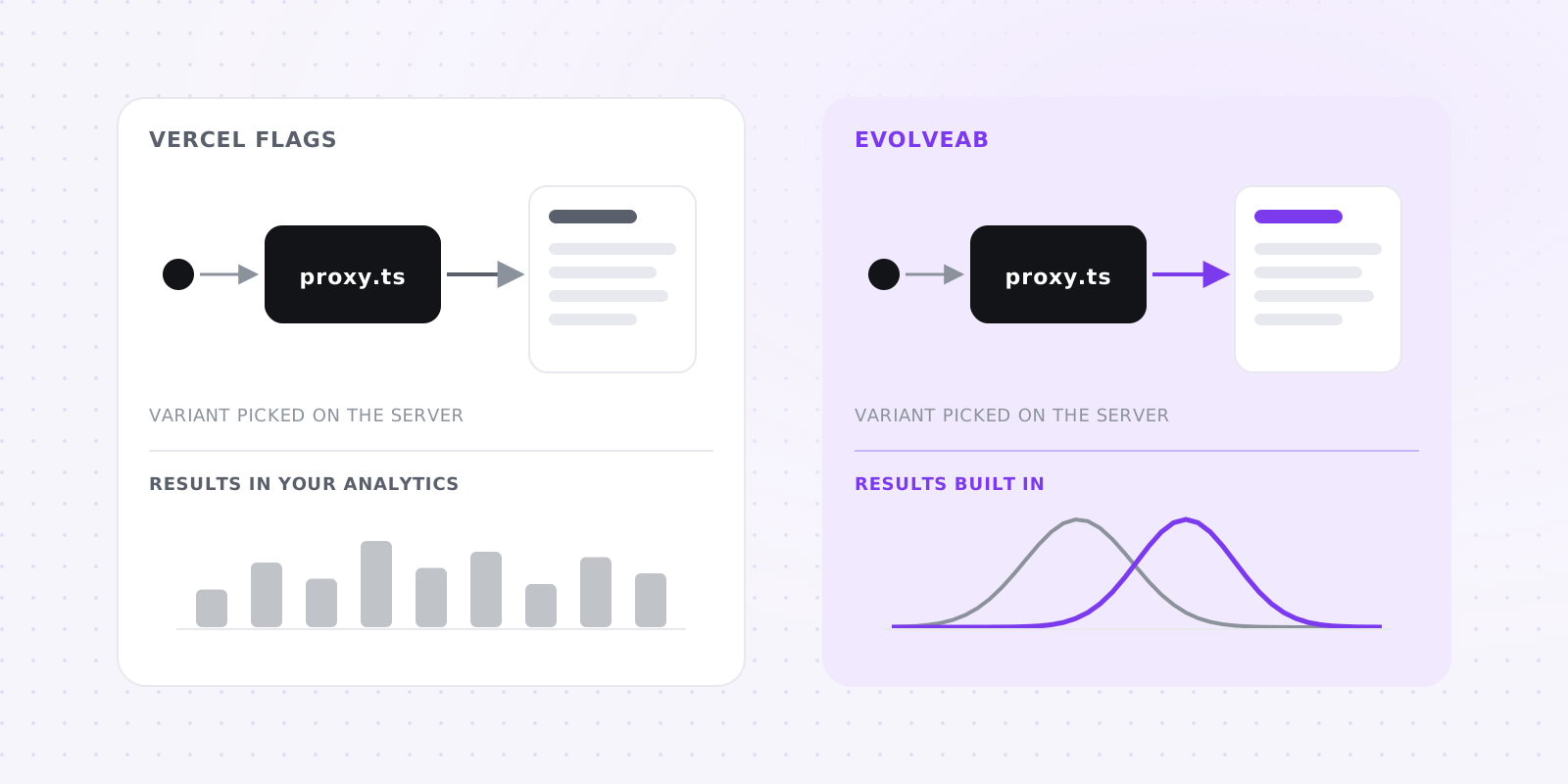
Short version: Vercel Flags is a feature flag service built into Vercel, and it does assignment well: targeting, segments, rollouts and static variants through the Flags SDK. Its own A/B testing docs send you to Web Analytics or your own analytics to read the result. evolveAB serves variants the same way, then works out the result: Bayesian statistics, bandits, guardrails, AI-written challengers and a pull request when a variant wins. Use Vercel Flags for feature flags across your codebase, and evolveAB to test and improve marketing pages.
We make evolveAB, so read this with that in mind. Every Vercel claim below links Vercel's own docs, checked on November 11, 2026. If something has changed, write to hello@evolveab.com and we'll fix it.
#Side by side
| Vercel Flags | evolveAB | |
|---|---|---|
| What it is | Feature flag provider in the Vercel dashboard: "Create flags, define targeting rules, run progressive rollouts, and run A/B tests" (docs) | A/B testing and bandits for UI regions in a Next.js App Router app |
| Frameworks | Flags SDK for Next.js and SvelteKit; OpenFeature; a core library (docs) | Next.js 15.5+ App Router only |
| Where the variant is decided | Server; precompute in the proxy for static pages (Flags SDK) |
Server, in proxy.ts, from a signed config held in memory |
| Reading results | "Measure the results through Web Analytics or your own analytics platform and data warehouse" (docs); the A/B test guide says to compare metrics per variant in Web Analytics (guide) | Built in: probability to beat control, lift and risk per variant (Bayesian) |
| Bandits | Not in the docs we read | Thompson sampling, recomputed at most hourly |
| Guardrails | Not in the docs we read | Guardrail goals, plus auto-rollback when a variant makes LCP, CLS or INP clearly worse |
| Ending a test | "Remove the flag from code and keep only the winning layout", then archive the flag (guide) | A pull request that commits the winner to your code; the experiment archives itself after the deploy (Growth plan and trial) |
| Writing variants | You write them in code | You or an AI write them in the dashboard, checked against the component's schema |
| Where event data lives | Web Analytics on Vercel, or your own analytics | Your Postgres; our cloud gets per-variant counts and sums only |
| Price | All plans. Hobby: 10,000 flag requests a month. Pro: $0.03 per 1,000 flag requests. Enterprise: custom (pricing) | Free plan; Pro $149 per site per month; Growth $499 per month; 30-day free trial |
| Limits | Hobby 100 flags, Pro 10,000 (limits) | Free 2 running experiments, Pro 10, Growth 30 |
Vercel labels its Web Analytics flag integration "available in Beta on all plans" (docs).
#Same serving model
A variant chosen in the browser either flickers or hides the page while a script loads. Vercel Flags and evolveAB both avoid that by choosing in the proxy and rendering on the server. The Flags SDK's precompute pattern encodes flag values into a path segment and rewrites to a prerendered page; evolveAB's static mode does the same for experiments, one cached render per variant. On Vercel, any proxy adds roughly 20 ms to a first page view (we measured 18 to 23 ms for a proxy that does nothing), and that applies to both.
They differ once traffic arrives. With Vercel Flags you decide what "winning" means, read the numbers in Web Analytics or your own tool, and call it when you've seen enough. evolveAB records exposures and goals to your database, computes the result, can shift traffic toward the leader, pauses a variant that hurts a guardrail or page speed, and opens the pull request when it's over.
#What we don't do
- Feature flags. We test UI regions on pages. We don't gate code paths, run kill switches or do percentage rollouts of a backend change.
- Other frameworks. Next.js App Router only; no Pages Router or SvelteKit.
- Layouts.
<Optimizable>works in pages, not in layouts yet. - Zero setup. You need Postgres (your app's existing database works) and
npx next-evolve init; Vercel Flags needs no database. - Free at small scale with no plan limits. Our Free plan caps you at 2 running experiments and 50,000 tested page views a month.
- A long track record. Sign-up opened in November 2026.
#When to pick Vercel Flags
- You need feature flags more than experiments: rollouts, entitlements, kill switches, per-environment values.
- You're on SvelteKit, or want OpenFeature.
- You already have analytics you trust and someone comfortable reading a split test from it.
- You run occasional tests and the cost of flag requests is a rounding error for you; at $0.03 per 1,000, a million flag requests cost $30 on Pro.
#When to pick evolveAB
- You want to test headlines and pricing copy on marketing pages, and want the statistics done for you.
- Low traffic makes a bandit more useful than a fixed split.
- You'd rather have an AI propose the next challenger, inside limits you set, than write every variant yourself.
- You want the winner back in your code as a reviewed pull request, with no leftover flag to delete.
Start a 30-day free trial, no card needed, or read the quickstart. The full background on serving variants is in our Next.js A/B testing guide.
#Questions
#Does Vercel Flags do A/B testing?
Yes. Vercel's docs say Vercel Flags supports A/B testing: you split users into buckets with a flag and measure the results through Vercel Web Analytics or your own analytics platform. Its docs don't describe a built-in statistics engine; the A/B test guide says to compare metrics per variant in Web Analytics.
#How much does Vercel Flags cost?
Vercel Flags is on all Vercel plans. Hobby includes 10,000 flag requests a month, Pro costs $0.03 per 1,000 flag requests and Enterprise is custom, according to Vercel's limits and pricing page (checked November 11, 2026).
#Is evolveAB built on Vercel Flags?
No. evolveAB has its own SDK, next-evolve, which picks the variant in proxy.ts from a signed config bundle. It uses the same serving idea as the Flags SDK's precompute pattern, and it runs on Vercel or any Node host.
#When is Vercel Flags the better choice?
When you need feature flags across your codebase (rollouts, entitlements, per-environment values), use SvelteKit or OpenFeature, or already have analytics you trust for reading tests. evolveAB only tests UI regions in the Next.js App Router.