evolveAB vs Statsig
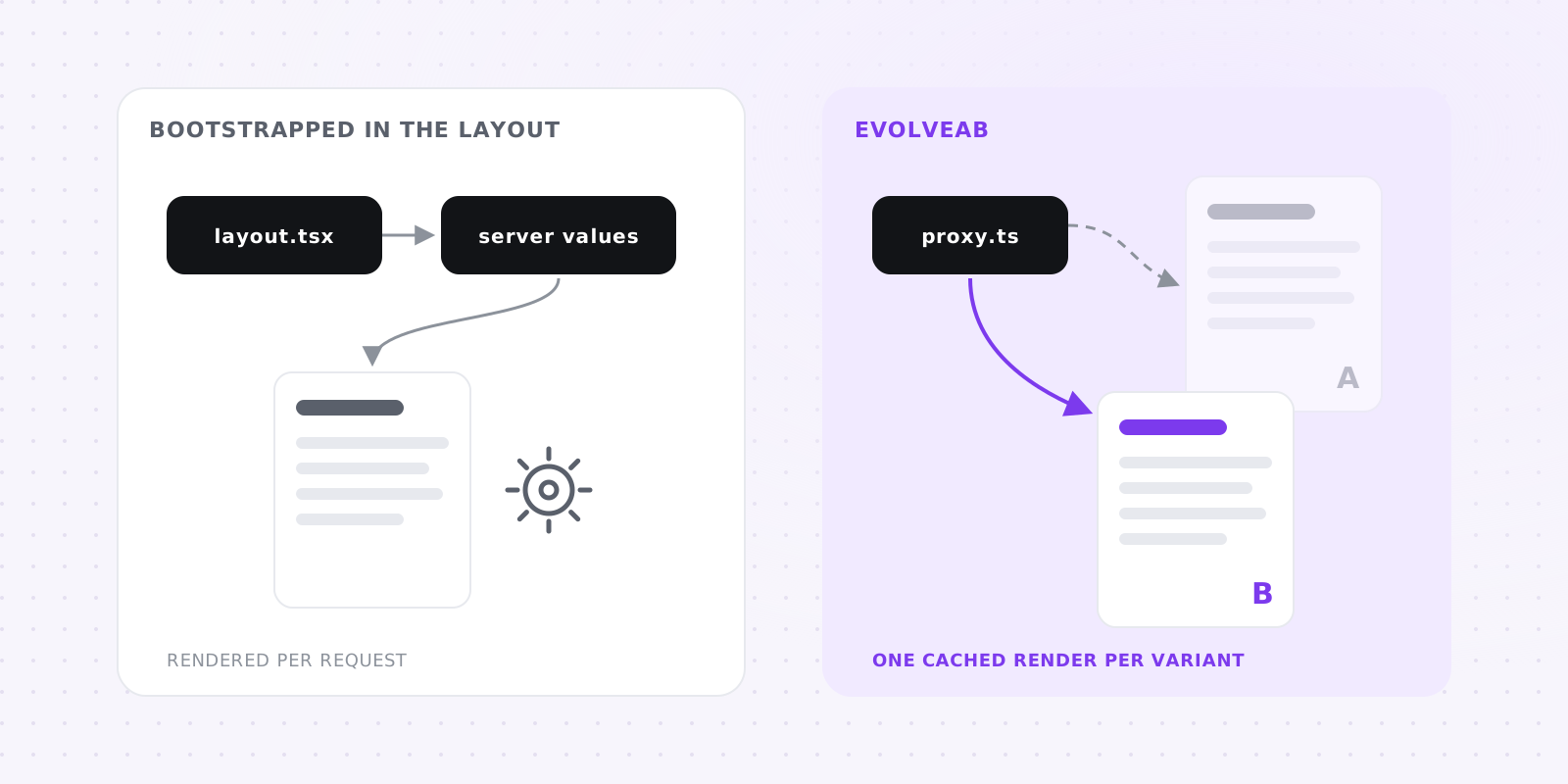
Short version: Statsig is a product experimentation platform with feature flags, product analytics and session replay, and its statistics go well past ours: t-tests, sequential testing, Bayesian tests, switchback tests, bandits and CUPED (docs). Its free Developer plan includes 2 million events a month and unlimited flag checks. For experiments across a whole product, Statsig is the stronger toolkit. evolveAB is built for marketing pages on the Next.js App Router: the variant is rendered on the server, raw events stay in your Postgres, an AI writes challengers within your rules, and winners come back as pull requests.
We make evolveAB, so read this with that in mind. Every Statsig claim below links Statsig's or Amplitude's own pages, checked on November 12, 2026. If something has changed, write to hello@evolveab.com and we'll fix it.
#Side by side
| Statsig | evolveAB | |
|---|---|---|
| What it is | Experiments, feature flags, product and web analytics, and session replay (pricing) | A/B tests and bandits for UI regions in a Next.js App Router app |
| Ownership | Statsig "was acquired by Amplitude on May 5, 2026"; "the product, brand, and customer base are now part of the Amplitude family" (Statsig) | Built and run by the Evolve team |
| Price | Developer free: 2M events a month, unlimited flag checks. Pro $150 a month: 5M events, then $0.05 per 1,000 events, one project per subscription. Enterprise custom (pricing) | Free (1 site, 1 user, 2 running experiments, 50,000 tested page views a month). Pro $149 per site per month. Growth $499 per month. 30-day free trial, no card |
| What gets metered | Events, including "exposures, log events, ingested metrics, and custom metrics" (pricing) | Tested page views, counted from the aggregates |
| Statistics | T-tests, sequential testing, Bayesian tests, switchback tests and multi-armed bandits (docs) | Bayesian (probability to beat control, lift, risk); Thompson-sampling bandits |
| Next.js | @statsig/next with a StatsigBootstrapProvider in the root layout, so pages render "without a blocking network request"; Edge Middleware with an Edge Config adapter for static pages (docs) |
Variant chosen in proxy.ts and rendered on the server; static mode caches one render per variant |
| Where event data lives | Statsig Cloud, or your warehouse with Warehouse Native, which is on Enterprise (pricing) | Your Postgres on every plan; our cloud receives per-variant counts and sums |
| Writing variants | Flag and experiment parameters, set in code or the console | Prop values in the dashboard, checked against the component's Zod schema; an AI can write them |
| Ending a test | You remove the gate or experiment from code | A pull request commits the winner; the experiment archives itself after the deploy (Growth plan and trial) |
#Statistics and scope
Statsig is built for product teams with real volume and someone who owns the data: many metrics per test, variance reduction, sequential testing for teams that look early, switchback tests for marketplaces. Our results are Bayesian only, with bandits and guardrails, because a marketing site mostly asks which version converts better and whether it's safe to ship. If you need more than that, use Statsig.
#Data and the App Router
On Statsig's cloud plans, events go to Statsig. Keeping raw data in your own warehouse is Warehouse Native, which the pricing page lists under Enterprise. With evolveAB, raw exposures and goals go to your own Postgres on every plan, including Free, and our cloud never connects to the database: it sends your app a signed request, and your app answers with four sums per variant per day.
For rendering, Statsig's App Router package bootstraps the client from the server in your root layout, so there's no flash while the browser waits for values. evolveAB decides earlier, in the proxy, and in static mode each variant is a cached page. Both avoid flicker; with evolveAB, init sets up the proxy and cached routes, while with Statsig you place the provider and decide how each page renders.
#About the ownership change
OpenAI agreed to buy Statsig in September 2025. Statsig's own post now says Amplitude acquired it on May 5, 2026, that the original team stayed at OpenAI, and that Amplitude "continues to develop Statsig." Amplitude describes the deal as a strategic partnership in which it will "take on Statsig's brand and customers" (Amplitude). If you're choosing a platform for the next few years, ask Amplitude how it plans to run Statsig next to its own experimentation products.
#What we don't do
- Feature flags or dynamic configs. We test UI regions on pages.
- Product analytics or session replay. We measure the goals you define for experiments.
- Frequentist, sequential or switchback tests, or CUPED. Bayesian only.
- A free tier as large as Statsig's. Our Free plan has 2 running experiments and 50,000 tested page views a month.
- Anything outside the Next.js App Router. No Pages Router, no mobile or backend SDKs.
- A long track record. Sign-up opened in November 2026.
#When to pick Statsig
- You experiment across a whole product (backend, mobile and web) with flags on the same platform.
- You need sequential, switchback or frequentist analysis, or CUPED.
- You want product analytics and session replay with your experiments.
- You're cost-sensitive at volume: 2 million free events a month covers a lot.
#When to pick evolveAB
- You test marketing pages on the Next.js App Router and want marketers to write or approve variants in a dashboard.
- Visitor-level data has to stay in your own database without an Enterprise contract.
- You want an AI to propose challengers within your rules, and bandits to move traffic to the leader.
- You want the winner back in your code as a pull request.
Start a 30-day free trial, no card needed, or read what leaves your server, call by call. Background on server-side testing with any tool: our Next.js A/B testing guide.
#Questions
#How much does Statsig cost?
Statsig's Developer plan is free with 2 million events a month and unlimited flag checks. Pro costs $150 a month with 5 million events, then $0.05 per 1,000 events, and covers one project. Enterprise is custom, according to Statsig's pricing page (checked November 12, 2026).
#Who owns Statsig now?
Statsig's blog says Amplitude acquired Statsig on May 5, 2026, after OpenAI's 2025 deal, and that the product, brand and customer base are now part of Amplitude while the original team stayed at OpenAI. Amplitude calls it a strategic partnership and says it will maintain and develop the Statsig platform.
#Does Statsig work with the Next.js App Router?
Yes. Statsig's docs say to install @statsig/next for the App Router and wrap the root layout in StatsigBootstrapProvider, which bootstraps the client from the server so pages render without a blocking network request. For static pages, the docs suggest Edge Middleware with Statsig's Edge Config adapter.
#When is Statsig the better choice?
When you experiment across a whole product, need sequential, switchback or frequentist statistics, want product analytics and session replay in one place, or want the larger free tier. evolveAB only tests UI regions in the Next.js App Router.