evolveAB vs Optimizely
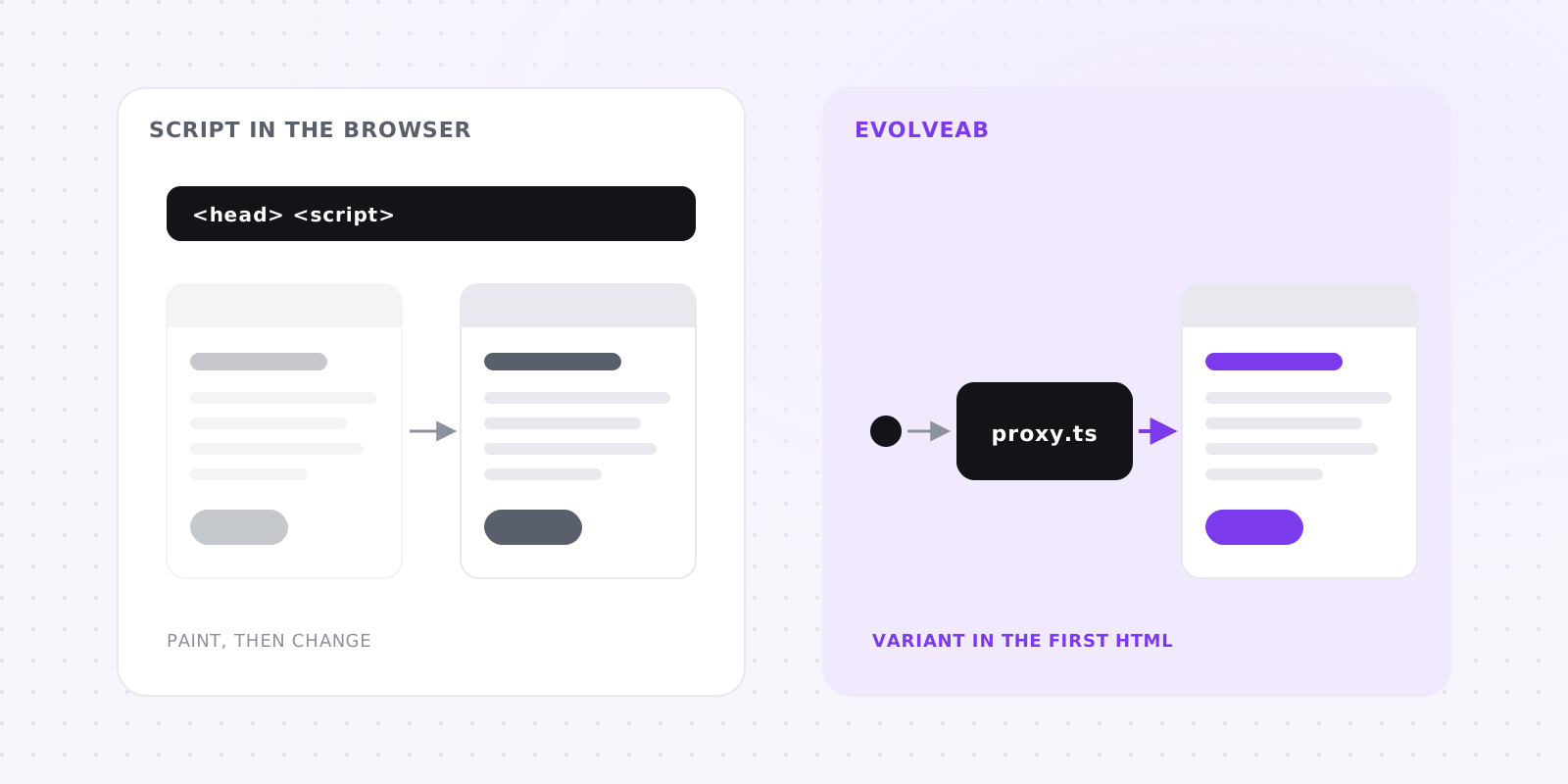
Short version: Optimizely covers far more ground than we do: a visual editor for marketers (Web Experimentation), SDKs for server-side and feature tests in most languages (Feature Experimentation), an edge option, and a stats engine built for teams that check results often. If you run experiments across many sites, apps and teams and have a budget agreed with a sales team, it's a strong choice. evolveAB only tests Next.js App Router pages. The variant is chosen in proxy.ts and rendered on the server, raw events stay in your Postgres, an AI writes challengers within your rules, and winners come back as pull requests.
We make evolveAB, so read this with that in mind. Every Optimizely claim below links Optimizely's own pages, checked on November 12, 2026. If something has changed, write to hello@evolveab.com and we'll fix it.
#Side by side
| Optimizely | evolveAB | |
|---|---|---|
| What it is | A suite: the plans page lists "A/B, multi-page, feature and server-side testing" (plans), with a visual editor for web tests (Web Experimentation) | A/B tests and bandits for UI regions in a Next.js App Router app |
| Price | Not published. "Get pricing tailored to your business," with a quote from the sales team (plans) | Free (1 site, 1 user). Pro $149 per site per month. Growth $499 per month for 3 sites and 5 team members, then $20 per seat. 30-day free trial, no card |
| How web tests run in Next.js | A snippet placed "as high as possible within the <head>"; Optimizely's React guide says hydration conflicts can show up as "flickering or flashing and lost or inconsistent changes" (docs) |
Variant chosen in proxy.ts and rendered on the server; no client-side changes |
| Edge option | Performance Edge decides at the CDN, then a microsnippet "runs in the visitor's browser, where it applies the set of changes" (docs) | Not needed: the proxy reads a signed config held in memory, with no network call per request |
| Server-side and feature tests | JavaScript SDK for Node 18+ and browsers, with starter kits for Vercel Edge Middleware, Cloudflare, Fastly, Akamai and AWS (SDK README) | npx next-evolve init sets up the proxy, routes and tables; App Router only |
| Statistics | Stats Engine, which uses "a tiered version of the Benjamini-Hochberg procedure for false discovery rate control" (docs) | Bayesian (probability to beat control, lift, risk); Thompson-sampling bandits |
| Where event data lives | Optimizely collects it; on Performance Edge a tracking snippet sends conversions and clicks to Optimizely (docs) | Your Postgres; our cloud receives per-variant counts and sums |
| Writing variants | Visual editor or code; the product page says its agents "help create variations faster" (Web Experimentation) | Prop values in the dashboard, checked against the component's Zod schema; an AI can write them within your forbidden claims and brand profile |
| Ending a test | You update the page or remove the experiment code | A pull request commits the winner; the experiment archives itself after the deploy (Growth plan and trial) |
#Where the variant gets decided
Optimizely Web Experimentation is a script: the page arrives, the snippet runs, and it changes the page in the browser. React then reconciles the DOM the snippet has touched, and Optimizely's own React guide warns this can show up as flicker or lost changes. It walks you through reactivating the snippet after hydration.
Performance Edge moves the decision to the CDN and makes the script smaller, but the changes are still applied in the visitor's browser. To decide on the server you'd use the Feature Experimentation SDK (there's a starter kit for Vercel Edge Middleware) and wire the datafile, rendering and event dispatch into your app yourself.
With evolveAB, init writes the proxy. It picks a variant from a signed config it already holds, and the page renders that variant once, cached per variant in static mode, so there's no snippet or anti-flicker timeout.
#What we don't do
- A visual editor. Variants are prop values on components a developer has marked as testable. Nobody can point and click at an arbitrary element.
- Anything outside the Next.js App Router. No Pages Router, no other frameworks, no mobile or backend SDKs.
- Feature flags or server-side logic tests. We test UI regions on pages.
- Frequentist or sequential analysis. Bayesian only.
- Enterprise procurement extras such as a long security review history or a named account team. Sign-up opened in November 2026, so there are no large customers or case studies yet.
#When to pick Optimizely
- You test across marketing sites on several frameworks, mobile apps and backend services.
- Your marketers want a visual editor that works on pages no developer has prepared.
- You want a stats engine built for checking many metrics continuously, with false discovery rate control.
- You need an established vendor with enterprise contracts and a long track record.
#When to pick evolveAB
- Your site is a Next.js App Router app and you want server-rendered tests without wiring an SDK into the proxy yourself.
- You'd like published prices and a trial you can start today, without a sales call.
- Visitor-level data has to stay in your own database.
- You want an AI to propose challengers within your rules, and the winner returned as a pull request.
Start a 30-day free trial, no card needed, or read the quickstart. For how server-side testing works in the App Router with any tool, see our Next.js A/B testing guide.
#Questions
#How much does Optimizely cost?
Optimizely doesn't publish prices. Its plans page says "Get pricing tailored to your business" and asks you to contact sales for a quote (checked November 12, 2026). evolveAB lists its prices: a Free plan, Pro at $149 per site per month and Growth at $499 per month.
#Does Optimizely flicker in Next.js?
It can. Optimizely's React server-side rendering guide says that with Web Experimentation the conflict with hydration "typically manifests as flickering or flashing and lost or inconsistent changes." It recommends placing the snippet high in the head and reactivating it after hydration. Feature Experimentation, Optimizely's SDK product, can decide on the server or at the edge instead.
#What is a good Optimizely alternative for Next.js?
If you need a visual editor across many sites, another enterprise suite is the closer swap. If you test marketing pages on the Next.js App Router, evolveAB renders the variant on the server, keeps raw events in your Postgres and has an AI write new challengers.
#When is Optimizely the better choice?
When you test across many frameworks, apps and backend services, want a visual editor, need sequential statistics with false discovery rate control, or need an enterprise vendor. evolveAB only tests UI regions in the Next.js App Router.