evolveAB vs LaunchDarkly
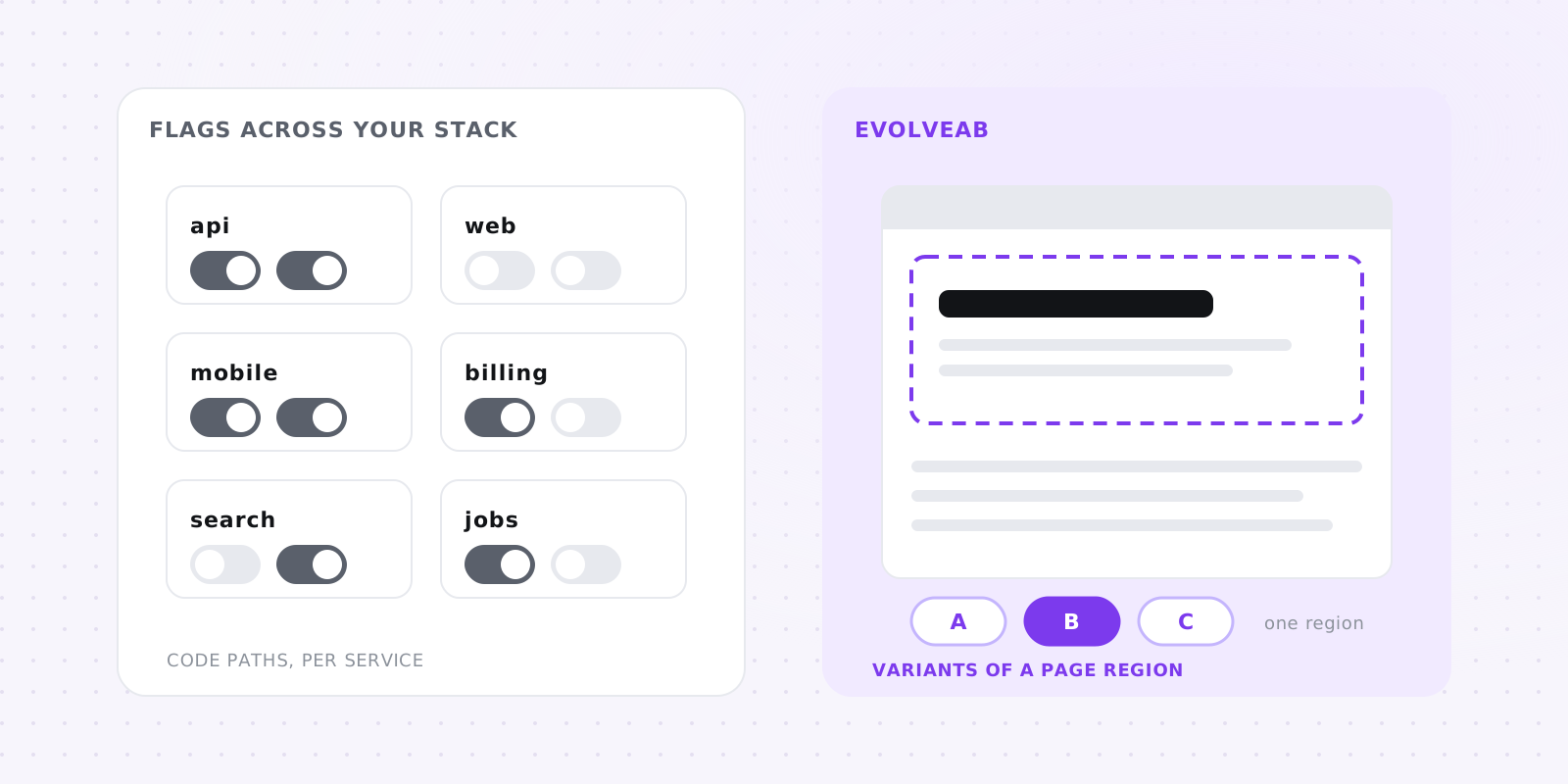
Short version: LaunchDarkly is a feature management platform first. Its flags control releases across every service you run, and experiments are built on those flags. Experimentation is on every plan, including the free Developer plan, with Bayesian and frequentist analysis, CUPED, bandits and warehouse-native results. If your engineers already ship behind LaunchDarkly flags, running experiments there is the obvious next step. evolveAB tests copy and layout on Next.js App Router pages. It picks the variant in proxy.ts, keeps raw events in your Postgres, has an AI write challengers within your rules, and sends winners back as pull requests.
We make evolveAB, so read this with that in mind. Every LaunchDarkly claim below links LaunchDarkly's own pages, checked on November 12, 2026. If something has changed, write to hello@evolveab.com and we'll fix it.
#Side by side
| LaunchDarkly | evolveAB | |
|---|---|---|
| What it is | Feature flags and release management, with experiments that "connect metrics to flags" (docs), plus observability and AI configs (pricing) | A/B tests and bandits for UI regions in a Next.js App Router app |
| Price | Developer $0 with 5 service connections, 1,000 client-side MAU and unlimited seats. Foundation is pay as you go: $12 per service connection and $10 per 1,000 client-side MAU billed monthly, less billed yearly. Enterprise custom (pricing) | Free (1 site, 1 user). Pro $149 per site per month. Growth $499 per month for 3 sites and 5 team members, then $20 per seat. 30-day free trial, no card |
| Experimentation on the free plan | Yes: "No limit on experimentation"; experiment approvals need Enterprise (pricing) | Free: 2 running experiments, 50,000 tested page views a month |
| Statistics | Bayesian and frequentist, CUPED, multi-armed bandits on every plan (pricing) | Bayesian (probability to beat control, lift, risk); Thompson-sampling bandits |
| Next.js | Server SDK plus a React provider that bootstraps the client so it starts "with real values instead of defaults" (bootstrapping); a Vercel edge SDK that reads flags from Edge Config (Vercel SDK) | npx next-evolve init writes the proxy, routes and tables; static mode caches one render per variant |
| Where event data lives | LaunchDarkly, or your warehouse with the warehouse-native integration (Snowflake, Redshift, Databricks, BigQuery and more) (pricing) | Your Postgres; our cloud receives per-variant counts and sums |
| Safe rollout | Guarded releases: "roll back automatically on a regression" (pricing) | Guardrail goals, and auto-rollback when a variant makes LCP, CLS or INP clearly worse |
| Writing variants | Flag variations, written in code or as flag values | Prop values in the dashboard, checked against the component's Zod schema; an AI can write them |
| Ending a test | You remove the flag and keep the winning code path | A pull request commits the winner; the experiment archives itself after the deploy (Growth plan and trial) |
#Flags you build on, or experiments you hand to marketing
LaunchDarkly asks "which code path should this user get?" A flag wraps a code path, an experiment attaches metrics to that flag, and the variations are whatever your engineers built. That suits a pricing algorithm, a new checkout or a backend change, in any service you run.
evolveAB asks "which version of this headline converts better?" A developer marks a component as testable once and says which props may change; after that, marketers write variants in the dashboard (or approve ones the AI writes) without a deploy. A winning variant comes back as a pull request, so there's no leftover flag to clean up.
#Flicker and the App Router
LaunchDarkly's documented pattern for React Server Components is bootstrapping: a server component evaluates the flags with the Node server SDK and passes them to a provider, so the browser starts with the real values and there's no flash of the default. That works, and it renders per request. On Vercel, LaunchDarkly's edge SDK can read flags from Edge Config instead, and from version 1.2.0 it can send events itself if you turn that on.
evolveAB chooses in proxy.ts before rendering and, in static mode, serves one cached render per variant, so a tested page can stay static. init writes that setup for you, though it only covers the pages and components you've configured.
#What we don't do
- Feature flags. No kill switches, entitlements, percentage rollouts of backend code or flags in other services.
- Frequentist analysis or CUPED. Bayesian only.
- Warehouse-native metrics. Goals are the ones you define in
evolve.goals.ts, written to Postgres by our routes. - Anything outside the Next.js App Router. No Pages Router, no mobile or backend SDKs.
- A long track record. Sign-up opened in November 2026, so there are no large customers or case studies yet.
#When to pick LaunchDarkly
- You need feature flags across many services and teams, with experiments on the same flags.
- You test backend or product logic, not only page copy.
- You want frequentist results, CUPED, or experiments read from your warehouse.
- You want experimentation on a free plan with unlimited seats, and your usage fits inside 5 service connections and 1,000 client-side MAU.
#When to pick evolveAB
- You test marketing pages on the Next.js App Router and want marketers to write or approve variants without a deploy.
- You want tested pages to stay statically cached, one render per variant.
- Visitor-level data has to stay in your own Postgres.
- You want an AI to propose challengers within your rules, and the winner returned as a pull request.
Start a 30-day free trial, no card needed, or read the quickstart. For how server-side testing works in the App Router with any tool, see our Next.js A/B testing guide.
#Questions
#Does LaunchDarkly include experimentation on the free plan?
Yes. LaunchDarkly's pricing page lists A/B/n testing, Bayesian and frequentist analysis, CUPED and multi-armed bandits as included on the Developer plan, with "No limit on experimentation." The Developer plan includes 5 service connections and 1,000 client-side monthly active users (checked November 12, 2026).
#How does LaunchDarkly avoid flicker in Next.js?
By bootstrapping. LaunchDarkly's docs show a server component that evaluates flags with the Node server SDK and passes them to a provider, so the client SDK starts with real values instead of defaults. On Vercel, its edge SDK can read flags from Edge Config.
#What is a good LaunchDarkly alternative for Next.js A/B testing?
If you need feature flags, another flag platform is the closer swap. For testing copy and layout on Next.js App Router pages, evolveAB keeps static pages cached per variant, stores raw events in your Postgres, has an AI write challengers and opens a pull request for the winner.
#When is LaunchDarkly the better choice?
When you need feature flags and release control across many services, test backend or product logic, want frequentist statistics, CUPED or warehouse-native results, or use a framework other than the Next.js App Router.