evolveAB vs GrowthBook
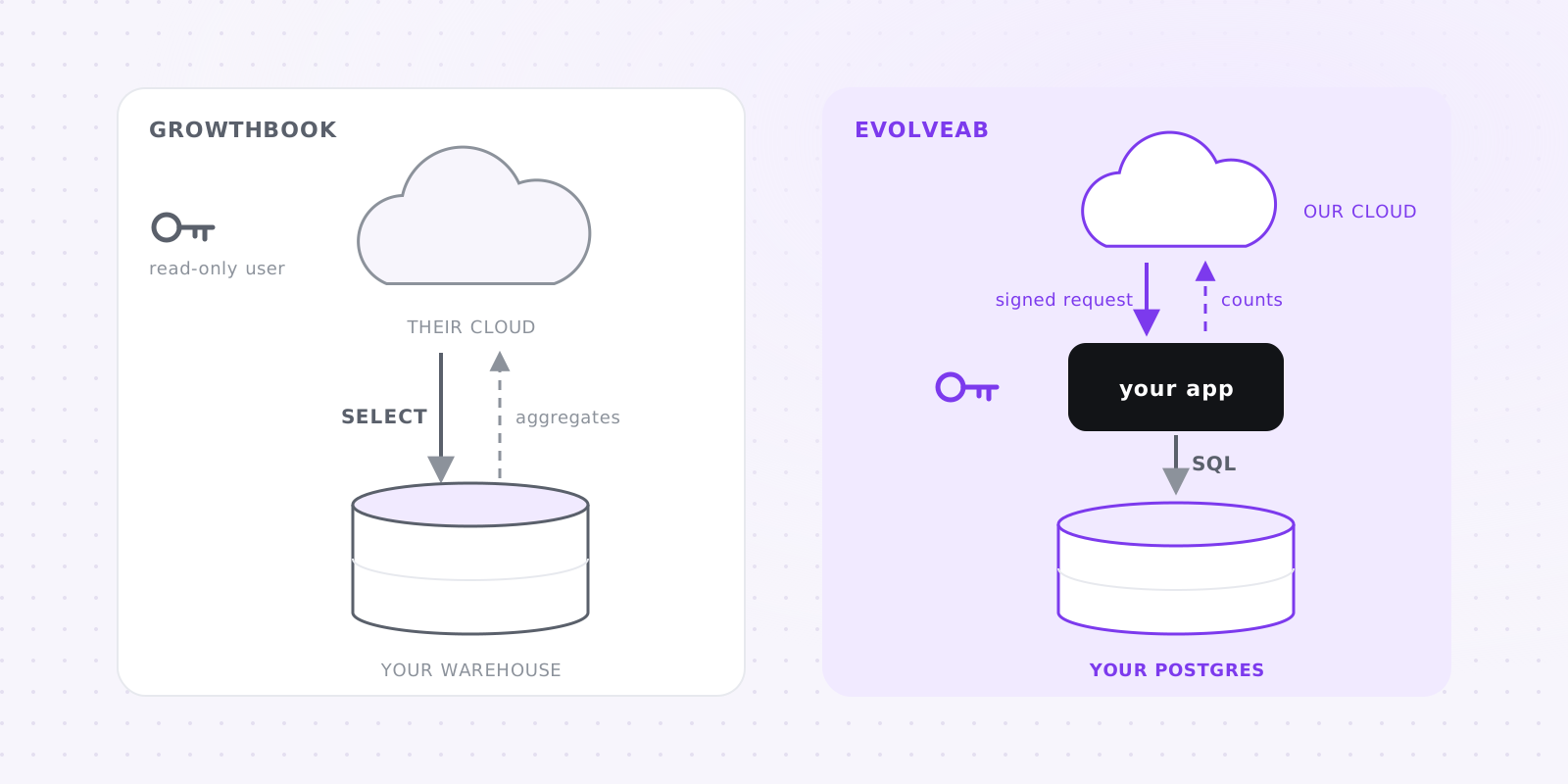
Short version: GrowthBook is the closest thing to us among developer tools, and in several ways it's the stronger product. It's open source, you can self-host it for free with unlimited users, it has feature flags, and its statistics go further than ours (frequentist and Bayesian, sequential testing, CUPED). It also keeps raw data in your warehouse, which can be Postgres. Pick evolveAB if you're on the Next.js App Router and want an AI to write variants, one command to set up flicker-free serving, and winners back as pull requests, with no outside service logging in to your database.
We make evolveAB, so read this with that in mind. Every GrowthBook claim below links GrowthBook's own pages, checked on November 11, 2026. If something has changed, write to hello@evolveab.com and we'll fix it.
#Side by side
| GrowthBook | evolveAB | |
|---|---|---|
| What it is | Feature flags and experimentation, open source (pricing) | A/B tests and bandits for UI regions in a Next.js App Router app |
| Licence | MIT, except the enterprise directories, which use the GrowthBook Enterprise License (LICENSE) | SDK (next-evolve) MIT; the cloud (statistics, AI, dashboard) is a hosted service |
| Self-hosting | Free self-hosted plan with "unlimited users" (pricing); needs Docker and MongoDB (docs) | The SDK runs in your app; the cloud isn't self-hostable |
| Where raw data lives | Your warehouse; GrowthBook "only runs SELECT queries" and "only the aggregated statistics are transmitted" (docs). Postgres, BigQuery, Snowflake, ClickHouse and more |
Your Postgres; our cloud receives per-variant counts and sums |
| How results get computed | GrowthBook connects to your database with a read-only user; GrowthBook Cloud connects from 52.70.79.40/32, so the database must be reachable from it (Postgres docs) |
Our cloud never connects to your database. It sends your app a signed request, and your app runs the SQL and answers with counts |
| Statistics | Bayesian and frequentist on every plan; sequential testing and CUPED on Pro and up (pricing) | Bayesian only (probability to beat control, lift, risk) |
| Bandits | Multi-arm bandits on Pro; contextual bandits on Enterprise (pricing) | Thompson sampling on every plan, including Free |
| Writing variants | AI Visual Editor on Pro (pricing), or variants in code | An AI writes challengers for a component, checked against its schema, locked fields and your forbidden claims, then a second model reviews them; you approve, or turn on autopilot |
| Ending a test | You remove the experiment code | A pull request commits the winner; the experiment archives itself after the deploy (Growth plan and trial) |
| Next.js | SDKs, plus a provider for Vercel's Flags SDK (Flags SDK docs) | npx next-evolve init sets up the proxy, routes and tables; App Router only |
| Price | Starter free, up to 3 users, 1 project. Pro $40 per seat per month, up to 30 users, 3 projects. Enterprise custom (pricing) | Free (1 site, 1 user). Pro $149 per site per month (1 user). Growth $499 per month for 3 sites and 5 team members, then $20 per seat. 30-day free trial |
#Who writes the SQL and who holds the keys
Both products keep visitor-level data out of the vendor's cloud. They get there differently.
GrowthBook is warehouse-native: you bring the events (from Segment, your own tracking or anything else that lands in a table), write or configure the metric SQL, and give GrowthBook a read-only login. GrowthBook Cloud then connects to your database from a fixed IP to run its queries. That suits a team with a warehouse and someone who owns the data, and you can test on any metric you can query.
evolveAB writes the events itself. init adds the tables and API routes to your app; page views, exposures and goals go to your own Postgres from your own origin. When our cloud needs numbers it sends a signed request, your app runs fixed SQL and answers with four sums per variant per day. There's no database login to share and no inbound connection to allow, but you're limited to the goals you define in evolve.goals.ts rather than arbitrary warehouse queries.
#Cost at a glance
For one person on one site, GrowthBook Starter is free and our Free plan is free. For a team of five, GrowthBook Pro is $200 a month ($40 × 5) for up to 3 projects, and evolveAB Growth is $499 a month for 3 sites. GrowthBook is cheaper there. The extra buys AI-written variants (1,500 generations a month on Growth), autopilot, Core Web Vitals rollback and winner pull requests. If you don't want those, GrowthBook is the better deal.
#What we don't do
- Feature flags. We test UI regions, not code paths.
- Frequentist analysis. Our results are Bayesian only, with no sequential testing or CUPED.
- Warehouse-native metrics. No goals written as SQL against BigQuery or Snowflake; events go to your Postgres through our routes.
- Self-hosting the whole thing. The SDK is open source; the cloud isn't.
- Frameworks besides the Next.js App Router. No Pages Router, no other frameworks, no mobile SDKs.
- A long track record. Sign-up opened in November 2026, so there are no large customers or case studies yet.
#When to pick GrowthBook
- You need feature flags as well as experiments, across more than one service or framework.
- You have a data warehouse and want experiment metrics defined in SQL against it.
- You need frequentist or sequential analysis, or CUPED for variance reduction.
- You want to self-host everything, or your team is large and per-seat pricing works out cheaper than per site.
#When to pick evolveAB
- Your site is a Next.js App Router app and you want server-rendered tests set up by one command.
- You'd like an AI to propose challengers within your rules, instead of writing every variant.
- You want winners returned as pull requests and finished tests to clean up after themselves.
- You don't want to give any outside service a login to your database.
Start a 30-day free trial, no card needed, or read the quickstart. For how server-side testing works in the App Router with any tool, see our Next.js A/B testing guide.
#Questions
#Is GrowthBook free?
GrowthBook Cloud's Starter plan is free for up to 3 users and 1 project, and the self-hosted open-source plan is free with unlimited users. Pro costs $40 per seat per month for up to 30 users, according to GrowthBook's pricing page (checked November 11, 2026).
#Does GrowthBook keep my data in my own database?
Yes. GrowthBook's docs say it queries your warehouse with SELECT queries and only aggregated statistics reach GrowthBook's servers. It connects to your database with a read-only user, so the database has to be reachable from GrowthBook Cloud or your self-hosted instance. evolveAB also keeps raw events in your Postgres, but its cloud never connects to the database; your app answers signed requests with counts.
#What is the main difference between GrowthBook and evolveAB?
GrowthBook is an open-source flag and experimentation platform that analyzes data already in your warehouse, with deeper statistics. evolveAB is App Router only: it writes the events to your Postgres itself, serves variants from proxy.ts, has an AI write new challengers, and opens a pull request when a variant wins.
#When is GrowthBook the better choice?
When you need feature flags or frequentist statistics, want metrics written as SQL against your warehouse, want to self-host, or use a framework other than the Next.js App Router. For a team that doesn't want AI-written variants or winner pull requests, GrowthBook also costs less.